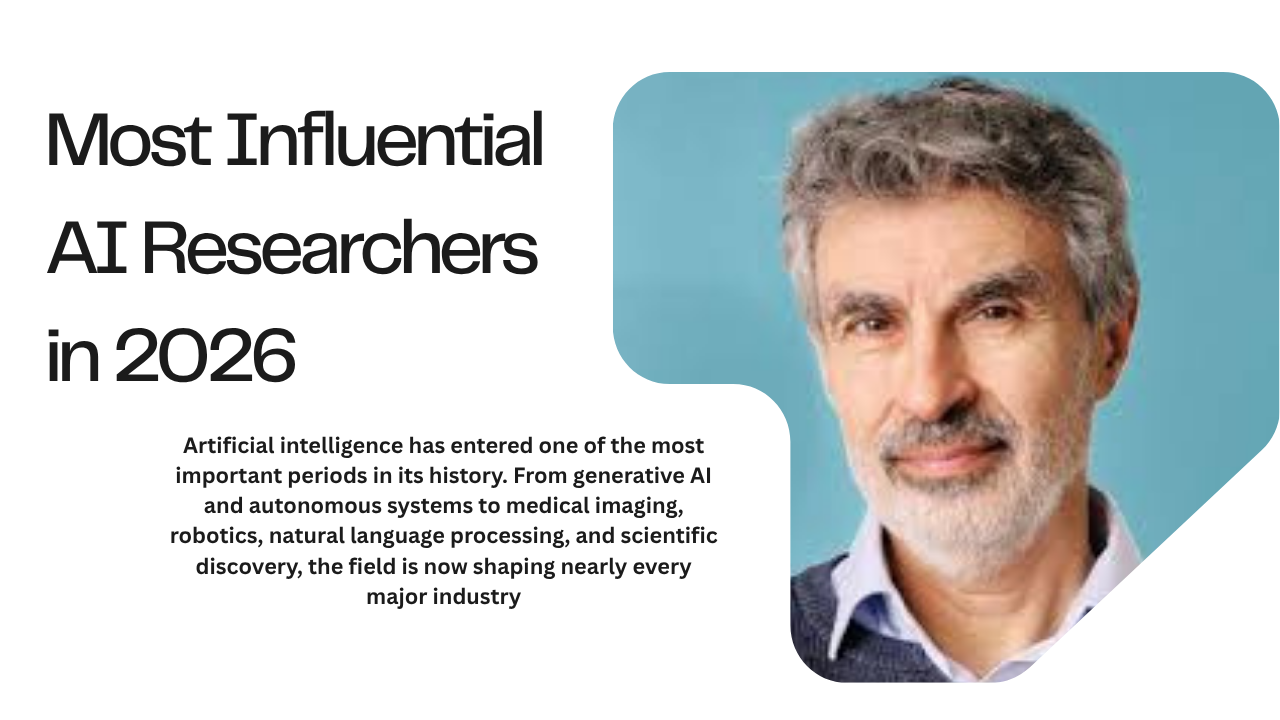
Artificial intelligence has entered one of the most important periods in its history. From generative AI and autonomous systems to medical imaging, robotics, natural language processing, and scientific discovery, the field is now shaping nearly every major industry. Behind this transformation are researchers whose ideas, papers, students, datasets, and algorithms have influenced the direction of modern computing.
Ranking AI researchers is not simple. Influence can be measured in many ways: academic citations, H-index, D-index, landmark discoveries, institutional leadership, industrial adoption, open-source contributions, awards, or long-term impact on other researchers. A citation-based ranking is useful because it shows how often a scholar’s work has been used, extended, or referenced by the global research community. However, it should not be treated as the only measure of importance.
The following 2026 ranking focuses on living researchers whose work has had exceptional influence in artificial intelligence, machine learning, computer vision, robotics, data mining, and natural language processing. The order is based mainly on citation volume, H-index-style research impact, and long-term contribution to AI-related fields. Citation counts are approximate because academic databases update continuously.
Top 20 AI Researchers in 2026 by Academic Influence
| Rank | Researcher | Key Focus Area | Approx. Citations |
|---|---|---|---|
| 1 | Yoshua Bengio | Deep learning, representation learning, AI safety | 651k+ |
| 2 | Andrew Zisserman | Computer vision, visual recognition | 403k+ |
| 3 | Geoffrey Hinton | Neural networks, deep learning | 370k+ |
| 4 | Anil K. Jain | Biometrics, pattern recognition | 279k+ |
| 5 | Michael I. Jordan | Machine learning, probabilistic modeling | 265k+ |
| 6 | Jiawei Han | Data mining, knowledge discovery | 232k+ |
| 7 | Luc Van Gool | Computer vision, 3D vision | 227k+ |
| 8 | Bernhard Schölkopf | Kernel methods, causality, ML theory | 213k+ |
| 9 | Yann LeCun | Convolutional neural networks, AI systems | 210k+ |
| 10 | Philip S. Yu | Data mining, graph analytics | 184k+ |
| 11 | Trevor Darrell | Computer vision, multimodal AI | 160k+ |
| 12 | Jitendra Malik | Computer vision, image segmentation | 150k+ |
| 13 | Takeo Kanade | Robotics, computer vision | 140k+ |
| 14 | Sebastian Thrun | Robotics, autonomous vehicles | 135k+ |
| 15 | Christopher D. Manning | Natural language processing | 130k+ |
| 16 | Cordelia Schmid | Computer vision, action recognition | 125k+ |
| 17 | Pieter Abbeel | Robotics, reinforcement learning | 115k+ |
| 18 | Fei-Fei Li | Computer vision, large-scale datasets | 110k+ |
| 19 | Andrew Y. Ng | Machine learning, AI education | 105k+ |
| 20 | Sergey Levine | Robot learning, reinforcement learning | 100k+ |
1. Yoshua Bengio
Yoshua Bengio is widely regarded as one of the most influential AI researchers in the world. His work on deep learning, neural networks, representation learning, and generative models helped form the foundation of today’s AI revolution. With more than 651,000 academic citations, he stands as one of the most-cited living researchers in computer science and artificial intelligence.
Bengio’s influence comes not only from his technical work but also from his leadership in shaping the direction of AI research. His contributions helped make deep learning practical and scientifically respected at a time when many researchers were still skeptical of neural networks. In recent years, he has also become an important voice in AI safety, responsible development, and the governance of advanced AI systems.
2. Andrew Zisserman
Andrew Zisserman is one of the most influential researchers in computer vision. His work has shaped how machines recognize objects, understand images, analyze video, and learn visual representations. Computer vision is now a core part of modern AI, powering applications such as autonomous vehicles, medical image analysis, facial recognition, robotics, surveillance, and multimodal AI systems.
Zisserman’s research has been heavily cited because it provided foundational tools and benchmarks for visual understanding. His influence is especially strong in deep visual recognition, image retrieval, and video analysis. As AI systems become increasingly multimodal, his work remains central to how machines interpret the visual world.
3. Geoffrey Hinton
Geoffrey Hinton is one of the best-known figures in artificial intelligence. Often described as one of the pioneers of deep learning, Hinton spent decades advancing neural network research long before it became dominant. His work on distributed representations, backpropagation-related learning systems, deep belief networks, and neural architectures helped revive interest in machine learning models inspired by the brain.
Hinton’s influence is difficult to overstate. Many of the systems behind today’s image recognition, speech recognition, language models, and generative AI are connected to ideas he helped develop. Along with Yoshua Bengio and Yann LeCun, he is often grouped among the researchers whose work made the modern deep learning era possible.
4. Anil K. Jain
Anil K. Jain is a leading figure in biometrics, pattern recognition, and computer vision. His research on fingerprint recognition, face recognition, and identity verification has influenced both academic research and real-world security systems. With nearly 279,000 citations, he is one of the most-cited researchers in AI-related computer science.
Jain’s work is especially important because it connects theoretical pattern recognition with practical applications. Biometric systems are now used in smartphones, border control, banking, law enforcement, and secure authentication. His research helped build the scientific foundation for these technologies while also raising important questions about privacy, fairness, and responsible use.
5. Michael I. Jordan
Michael I. Jordan is one of the most respected names in machine learning, statistics, and artificial intelligence. His work spans probabilistic graphical models, Bayesian methods, optimization, statistical learning, and large-scale data analysis. He has helped define machine learning as a rigorous scientific discipline, grounded in mathematics and statistics.
Jordan’s influence is broad because his research shaped how scientists understand uncertainty, inference, prediction, and decision-making. While deep learning often dominates public discussion, much of modern AI still depends on the statistical foundations that Jordan and others helped develop. His work continues to influence both theoretical machine learning and applied AI systems.
6. Jiawei Han
Jiawei Han is a major researcher in data mining and knowledge discovery. His work focuses on extracting useful patterns, relationships, and insights from large datasets. This makes his research highly relevant to AI, because intelligent systems depend heavily on data quality, data structure, and scalable analysis.
Han’s contributions include work on frequent pattern mining, clustering, information networks, text mining, and knowledge discovery. These areas are essential for recommendation systems, search engines, enterprise analytics, fraud detection, and large-scale AI platforms. His citation record reflects the importance of data mining as a foundation for modern machine intelligence.
7. Luc Van Gool
Luc Van Gool is one of the leading researchers in computer vision, especially in 3D reconstruction, object recognition, tracking, and scene understanding. His work has influenced how machines interpret visual environments, reconstruct physical spaces, and understand movement.
Computer vision remains one of AI’s most important fields because it connects digital intelligence with the physical world. Van Gool’s research has supported progress in autonomous driving, robotics, augmented reality, mapping, and industrial inspection. His high citation count reflects the long-term importance of visual perception in AI.
8. Bernhard Schölkopf
Bernhard Schölkopf is known for his work on kernel methods, support vector machines, statistical learning theory, and causal machine learning. His research has had a major impact on both the theory and practice of machine learning.
Schölkopf’s influence is especially important because AI is moving beyond simple prediction. Modern systems increasingly need to understand cause and effect, adapt to changing environments, and make reliable decisions under uncertainty. His work on causality and robust learning is therefore highly relevant to the next generation of AI.
9. Yann LeCun
Yann LeCun is one of the pioneers of convolutional neural networks and modern deep learning. His early work on neural networks for image and document recognition laid the groundwork for many of today’s computer vision systems. Convolutional networks became one of the most important architectures in AI, especially for visual recognition tasks.
LeCun’s influence extends beyond research papers. He has played a major role in connecting academic AI research with industrial AI development. His work on self-supervised learning and world models continues to shape debates about how future AI systems should learn from data more efficiently.
10. Philip S. Yu
Philip S. Yu is a highly influential researcher in data mining, database systems, graph analytics, and social network analysis. His work has helped researchers and engineers understand how to process large, complex, and interconnected datasets.
Yu’s research matters because modern AI is not only about algorithms; it is also about data infrastructure. Systems that recommend products, detect fraud, analyze social networks, or model relationships between entities all rely on ideas from data mining and graph analysis. His high citation count reflects the practical importance of these areas.
11. Trevor Darrell
Trevor Darrell is a leading researcher in computer vision and machine learning. His work has influenced object recognition, domain adaptation, multimodal learning, and visual understanding. He has also contributed to the development of AI systems that connect vision with language and action.
Darrell’s influence is especially visible in the rise of multimodal AI. Today’s most advanced systems are expected to process text, images, video, and sometimes audio together. His research helped build the foundations for this broader understanding of machine perception.
12. Jitendra Malik
Jitendra Malik is one of the most important researchers in computer vision, particularly in image segmentation, object recognition, and visual grouping. His work helped machines move from simply detecting pixels to understanding meaningful visual structures.
Malik’s research has influenced generations of computer vision scientists. Image segmentation, one of his key areas, remains essential for medical imaging, autonomous driving, robotics, satellite analysis, and visual scene understanding. His long-term impact places him among the most influential AI researchers in 2026.
13. Takeo Kanade
Takeo Kanade is a pioneer in robotics and computer vision. His work has influenced face detection, 3D vision, motion analysis, autonomous systems, and robotic perception. He is one of the researchers who helped connect visual intelligence with machines that act in the real world.
Kanade’s importance lies in the practical nature of his contributions. Robotics requires perception, planning, movement, and adaptation. His research helped advance the ability of machines to interpret their surroundings and respond intelligently.
14. Sebastian Thrun
Sebastian Thrun is best known for his work in robotics, autonomous vehicles, probabilistic robotics, and online education in AI. His research helped bring autonomous driving from a research dream closer to real-world deployment.
Thrun’s work has influenced robotics, mapping, localization, and decision-making under uncertainty. He has also played an important role in making AI education accessible to a global audience. This combination of research impact and public education gives him a distinctive place in the AI landscape.
15. Christopher D. Manning
Christopher D. Manning is one of the most influential researchers in natural language processing. His work has shaped how machines parse, understand, and generate human language. In the age of large language models, his area of research has become one of the most visible parts of AI.
Manning’s contributions include work on statistical NLP, dependency parsing, sentiment analysis, information extraction, and neural language understanding. As AI systems become more conversational and language-driven, his research continues to influence both academic work and commercial applications.
16. Cordelia Schmid
Cordelia Schmid is a major figure in computer vision, especially in image and video recognition. Her research has influenced local visual features, object recognition, action recognition, and large-scale visual learning.
Schmid’s work is important because video understanding is one of the next major frontiers in AI. Machines are increasingly expected not only to recognize objects but also to understand actions, events, and context over time. Her research helped build the foundation for this shift from still-image recognition to dynamic visual understanding.
17. Pieter Abbeel
Pieter Abbeel is a leading researcher in robotics, reinforcement learning, imitation learning, and robot manipulation. His work focuses on helping machines learn complex behavior from data, demonstrations, and interaction with the environment.
Abbeel’s influence is especially strong in embodied AI, where intelligence is not limited to text or images but connected to physical action. As robotics becomes more important in manufacturing, logistics, home assistance, and autonomous systems, his research remains highly relevant.
18. Fei-Fei Li
Fei-Fei Li is one of the most influential researchers in computer vision and human-centered AI. She is widely recognized for her role in advancing large-scale visual recognition and for helping establish the importance of high-quality datasets in AI progress.
Her work showed that data scale could dramatically improve machine perception. This idea became central to modern AI, where large datasets are often as important as algorithms. In addition to her technical influence, Li has become a prominent advocate for ethical, inclusive, and human-centered artificial intelligence.
19. Andrew Y. Ng
Andrew Y. Ng has had an enormous influence on machine learning research, AI education, and applied AI. His work includes contributions to deep learning, online learning, robotics, and large-scale machine learning systems.
Ng’s influence is unique because it extends far beyond academic citations. He has helped educate millions of learners and has played a major role in bringing AI into business, healthcare, manufacturing, and software development. His combination of research, teaching, and entrepreneurship makes him one of the most recognizable AI figures in the world.
20. Sergey Levine
Sergey Levine is one of the leading researchers in robot learning, reinforcement learning, and embodied intelligence. His work focuses on how machines can learn skills through interaction, simulation, data, and experience.
Levine’s research is especially important for the future of AI because many current systems are strong at language and perception but weak at physical action. Robot learning aims to close that gap. His work represents a new generation of AI research focused on agents that can act intelligently in real environments.
Key Trends Behind the 2026 Ranking
The 2026 ranking reveals several important trends in AI research.
First, deep learning remains the most powerful driver of citation impact. Researchers such as Yoshua Bengio, Geoffrey Hinton, and Yann LeCun continue to rank highly because their work created the foundation for modern neural networks. Their ideas shaped the systems behind today’s generative AI, speech recognition, image recognition, and large-scale learning.
Second, computer vision is one of the strongest fields in AI. Researchers such as Andrew Zisserman, Luc Van Gool, Jitendra Malik, Cordelia Schmid, Fei-Fei Li, and Trevor Darrell have accumulated major influence because visual understanding is essential for robotics, medical imaging, autonomous vehicles, surveillance, augmented reality, and multimodal AI.
Third, data mining and statistical learning remain central to artificial intelligence. Jiawei Han, Philip S. Yu, Michael I. Jordan, and Bernhard Schölkopf show that AI is not only about neural networks. It also depends on data structures, probability, causality, optimization, and mathematical reasoning.
Fourth, robotics and embodied AI are becoming more important. Researchers such as Takeo Kanade, Sebastian Thrun, Pieter Abbeel, and Sergey Levine represent the effort to move AI from screens and servers into the physical world. Their work connects perception, planning, control, and learning.
Final Thoughts
The most influential AI researchers in 2026 are not simply people with large citation counts. They are scholars whose ideas became building blocks for entire research communities. Their work helped machines see, learn, reason, classify, translate, recognize speech, mine data, understand language, and interact with the physical world.
Citation rankings are useful, but they should be read carefully. Some researchers have enormous influence through teaching, open-source tools, public leadership, or industrial deployment that may not be fully captured by citation metrics. Others may be newer researchers whose most important contributions are still accumulating academic recognition.
Still, the researchers listed here represent the intellectual foundation of modern AI. Their contributions explain how artificial intelligence moved from a specialized academic field to one of the most transformative technologies of the twenty-first century. As AI continues to evolve in 2026 and beyond, their work will remain central to understanding where the field came from and where it is going.
Faqs
What criteria determine the top AI researchers in 2026?
Ranking is based on citation counts and H-index/D-index in AI-related publications.
Who is the most-cited AI researcher in 2026?
Yoshua Bengio, with over 651,000 citations.
Why are Hinton, Bengio, and LeCun called the “godfathers of AI”?
They pioneered deep learning and modern neural networks.
Are only deep learning researchers included in the ranking?
No; it also includes experts in computer vision, robotics, NLP, and data mining.
Do citation counts fully reflect a researcher’s influence?
No; teaching, mentorship, open-source contributions, and industrial impact are not captured by citations.
Which AI fields generate the highest citation counts?
Deep learning, computer vision, and data-driven machine learning lead in citations.
How do emerging AI researchers fit into these rankings?
Rising stars in robotics, reinforcement learning, and multimodal AI are increasingly influential.
Are top researchers concentrated in specific institutions?
Yes; many are affiliated with elite universities like Stanford, MIT, UC Berkeley, and Montreal.
What is the difference between citations, H-index, and D-index?
Citations count references; H-index measures productivity + impact; D-index is discipline-specific for computer science.
Why is knowing top AI researchers important?
It helps track foundational ideas, emerging trends, and leaders shaping AI’s future.