The role of technical post-sales leaders in the realm of AI developer tooling is becoming increasingly important as AI adoption continues to accelerate across industries. These professionals are responsible for ensuring that customers successfully implement, adopt, and derive business value from AI tools, developer APIs, and related technologies. Their work blends deep technical knowledge with customer-centric consulting, making them pivotal in driving AI solutions from implementation to long-term success.
As we move into 2026, the landscape for technical post-sales leaders is evolving. To stay effective and deliver value, these professionals must be well-versed in various technical areas, including AI model deployment, API integration, and cloud infrastructure. They must also be adept at managing complex integration workstreams, troubleshooting AI implementation issues, and ensuring that business goals align with technical milestones.
Key Competencies for Technical Post-Sales Leadership in AI
1. AI and Technical Expertise
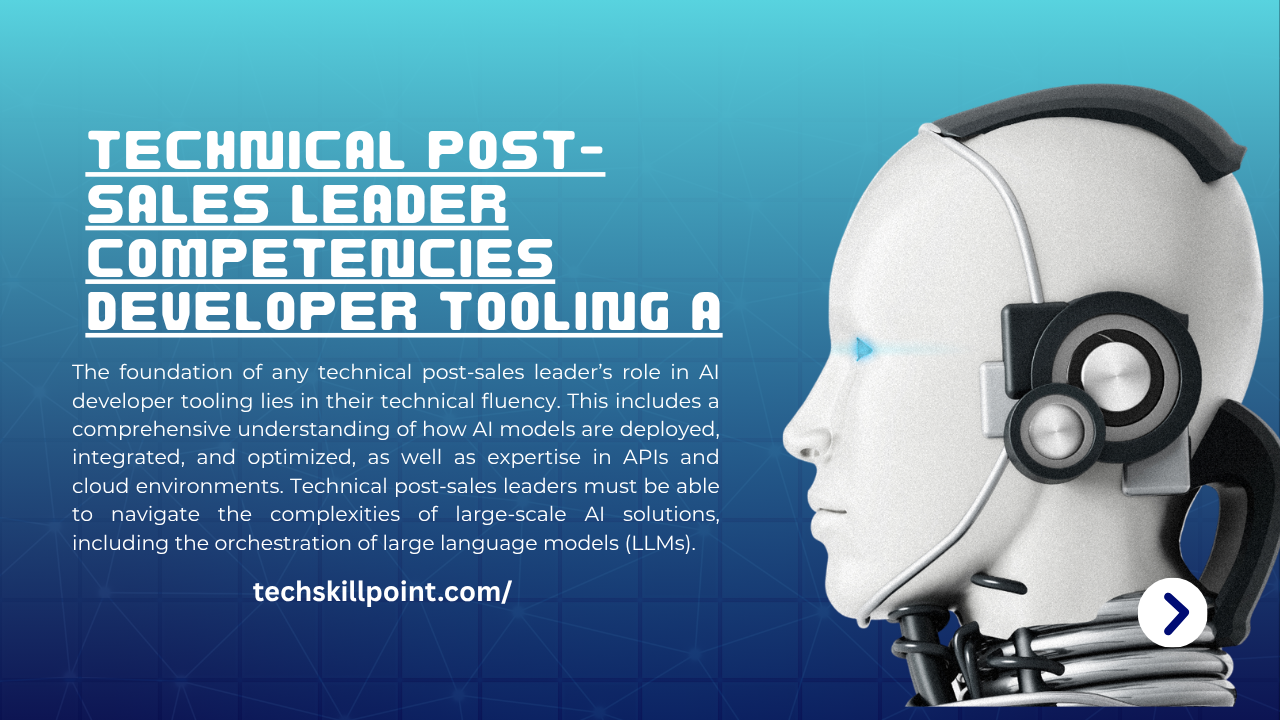
The foundation of any technical post-sales leader’s role in AI developer tooling lies in their technical fluency. This includes a comprehensive understanding of how AI models are deployed, integrated, and optimized, as well as expertise in APIs and cloud environments. Technical post-sales leaders must be able to navigate the complexities of large-scale AI solutions, including the orchestration of large language models (LLMs).
These professionals should possess deep technical skills to troubleshoot complex AI systems, ensuring that clients’ environments are optimized for the best performance. This technical proficiency allows post-sales leaders to manage the integration of AI systems into a customer’s existing infrastructure while ensuring smooth deployments and minimizing technical friction.
2. Customer-Centric Onboarding and Consulting
A core responsibility of a post-sales leader is customer-centric onboarding. Unlike traditional sales roles, which focus primarily on closing deals, technical post-sales leaders guide clients through the entire implementation process. Their primary objective is to help customers understand how to get the most out of their developer tooling and AI systems.
Effective onboarding involves setting clear success criteria, validating prerequisites, and establishing a roadmap for technical adoption. Leaders must ensure that the customer fully understands the capabilities and features of the AI tools, making it easier for the client to begin using them in their workflows. By providing tailored, hands-on consulting, technical post-sales leaders ensure a smooth transition from the initial purchase to full-scale usage, which directly impacts adoption rates and customer satisfaction.
3. Managing Complex Integration and Troubleshooting
A significant portion of a technical post-sales leader’s work revolves around managing complex integration workstreams. This involves overseeing the technical implementation of AI solutions, ensuring they are integrated seamlessly into the customer’s infrastructure. Post-sales leaders must also be able to troubleshoot any issues that arise during this process, whether they are related to API connectivity, cloud compatibility, or AI model performance.
This competency requires a strong ability to diagnose problems and collaborate with cross-functional teams, such as engineering and product teams, to resolve issues efficiently. Being able to troubleshoot in real time helps minimize downtime and ensures that customers can continue using the AI tools without significant disruptions.
4. Operational Excellence and Tracking Progress
In addition to technical expertise, post-sales leaders are tasked with ensuring operational excellence throughout the customer journey. This includes tracking the progress of technical implementations, identifying potential roadblocks, and maintaining detailed technical records such as architectural diagrams, configurations, and deployment logs. These records not only help ensure that integrations are performed correctly but also provide valuable insights into system performance over time.
Post-sales leaders play an essential role in keeping projects on track, ensuring deadlines are met, and guiding clients through any challenges that might arise. They are also responsible for helping customers maximize their time-to-value, ensuring that their investments in AI tools deliver the promised benefits.
5. Strategic Advisory and Business Impact
One of the most valuable aspects of a technical post-sales leader’s role is their ability to act as a strategic advisor. By helping clients connect the technical features of AI tools with tangible business outcomes, they prove the return on investment (ROI) and demonstrate the value of the AI solution to the client’s bottom line. This is especially important during contract renewals, where clients are looking for measurable benefits from the tools they have implemented.
By working closely with clients to map technical features to business needs, post-sales leaders help customers understand how AI solutions can address specific pain points or drive new opportunities. This value mapping is crucial for fostering long-term relationships and ensuring that clients continue to renew their contracts.
6. Product-Led Growth Approach
Product-led growth (PLG) is an approach that emphasizes the importance of product quality, user experience, and ease of adoption over traditional high-pressure sales tactics. In the context of AI developer tooling, PLG involves focusing on ease of use, accessible documentation, and active community engagement to drive customer success and retention.
Post-sales leaders in the AI space need to align their efforts with a product-led mindset, focusing on helping customers quickly see the value in the AI tools through intuitive user interfaces and minimal friction during onboarding. This approach is especially effective in business-to-developer (B2D) sales, where customer adoption is driven by how well the product integrates into a developer’s workflow.
Essential Skills for Success in 2026
1. Prompt Engineering and AI Literacy
As AI continues to evolve, understanding prompt engineering—the practice of crafting inputs for large language models to generate desired outputs—has become an essential skill for technical post-sales leaders. This is especially important when working with AI-powered tools that involve natural language processing (NLP) and text generation.
Being well-versed in how to configure and optimize AI systems for various tasks allows post-sales leaders to guide clients more effectively. AI literacy extends beyond understanding how to use the tools; it also involves knowing how to optimize and fine-tune them to achieve specific business outcomes. This technical expertise ensures that AI systems are fully leveraged for maximum impact.
2. Data-Driven Decision Making
In 2026, the ability to make data-driven decisions is crucial for any technical post-sales leader. AI-powered tools that analyze customer data can help identify clients who may be at risk of churn and those who are ready for expansion. By using these tools, post-sales leaders can proactively engage with clients, addressing issues before they become major problems and identifying opportunities to expand the usage of AI tools across other parts of the business.
Post-sales leaders must be comfortable with analyzing data and using insights to make strategic recommendations. This allows them to be more than just technical advisors—they become trusted partners who guide customers toward continued success with the AI tools.
3. Cross-Functional Collaboration and Leadership
Post-sales leaders must possess excellent leadership and cross-functional collaboration skills. They need to be able to work effectively with teams across engineering, product, sales, and support to translate customer feedback into actionable product improvements. The ability to bridge the gap between technical and non-technical teams ensures that customer feedback is understood and acted upon promptly.
As AI tools become more complex, post-sales leaders will be essential in accelerating customer time-to-value by ensuring that feedback loops between customers and product teams are clear and efficient. They will also play a key role in ensuring that technical teams are aligned with customer needs, fostering smoother product updates and more impactful releases.
Conclusion: The Future of Technical Post-Sales Leadership in AI
The role of technical post-sales leaders in AI developer tooling is critical to the success of AI solutions in the enterprise space. As AI technologies continue to evolve, post-sales leaders will need to possess a broad set of technical and business competencies to drive adoption, troubleshoot issues, and demonstrate ROI to customers. Their ability to combine AI fluency, customer-focused implementation, and operational excellence will be key to their success.
In 2026 and beyond, the demand for post-sales leaders who can bridge the gap between technical solutions and business value will only increase. As AI becomes more integrated into every aspect of business, those who excel in this field will continue to be indispensable, helping customers realize the full potential of their AI investments and ensuring that AI tools become an integral part of their operations.
FAQs About Technical Post-Sales Leaders in AI Developer Tooling
What are the key competencies required for a technical post-sales leader in AI developer tooling?
Key competencies include AI fluency, customer-centric implementation, managing complex integrations, strategic advisory, and a product-led growth mindset. These leaders must blend technical expertise with a focus on customer adoption and business value.
What is product-led growth (PLG) in the context of AI tooling?
In the AI space, PLG focuses on user-friendly tools, minimal friction during onboarding, and creating value through product design. Post-sales leaders drive adoption by ensuring customers can easily understand and use AI tools, fostering organic growth.
Why is AI literacy important for post-sales leaders?
AI literacy, including understanding prompt engineering and optimizing AI systems, is crucial for helping customers configure and maximize the impact of AI tools, ensuring they meet specific business goals.
How do data-driven decisions impact post-sales leadership?
Post-sales leaders can use AI-powered tools to monitor customer health and identify clients who are at risk or primed for expansion. This enables proactive engagement and improves customer retention and growth.
How do post-sales leaders bridge gaps between teams?
Effective cross-functional leadership ensures that customer feedback is communicated clearly across engineering, product, and sales teams, leading to better alignment between product features and customer needs.